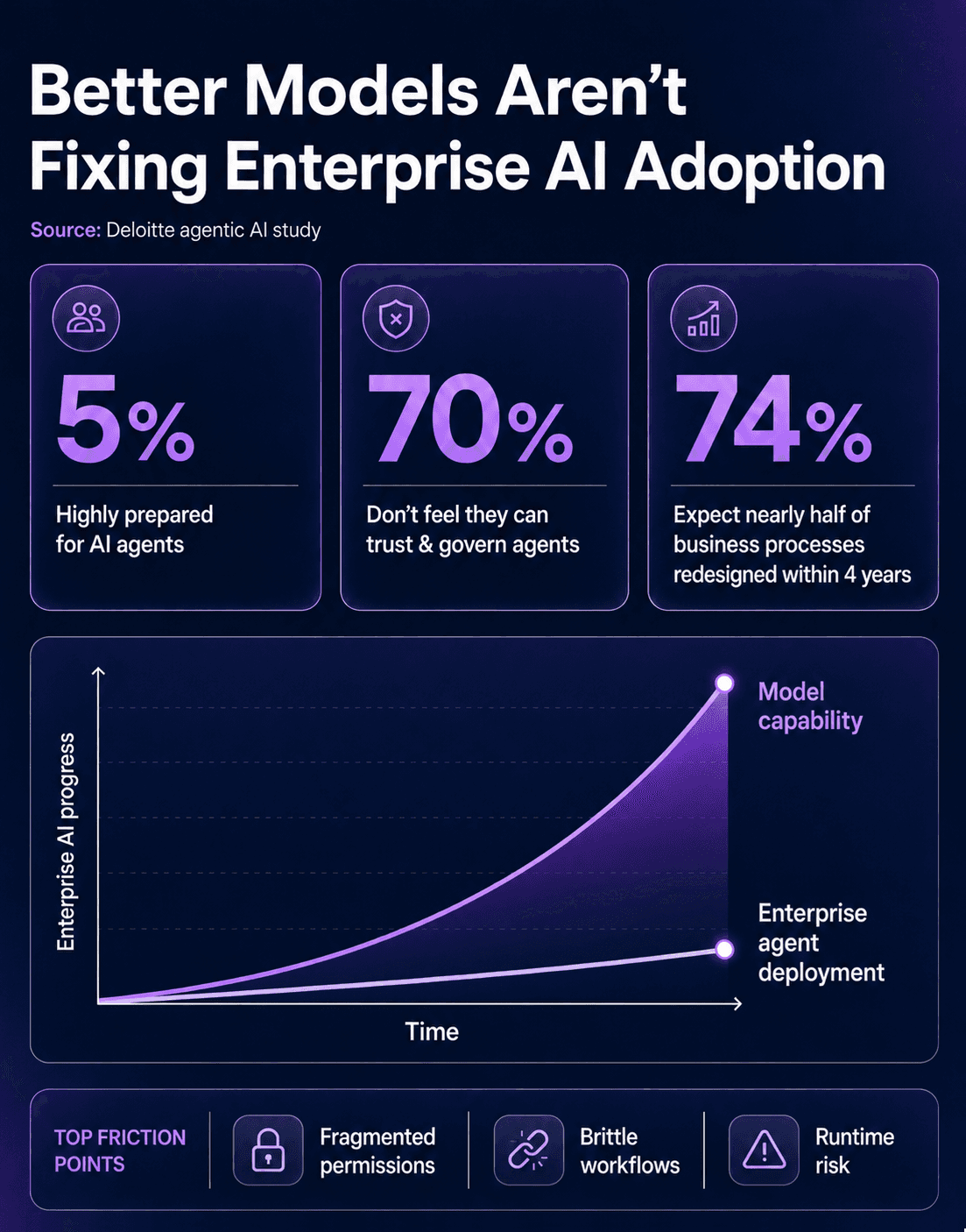
AI models are moving faster than enterprises can safely deploy them.
Something in Deloitte's latest agentic AI study caught my attention.
Only 5% of organizations said their business processes are highly prepared for AI agents and 70% said they don't feel they can trust and govern agents. At the same time, 74% expect nearly half of their business processes to be redesigned around AI agents within four years.
That is a pretty big gap between where companies want to go and what they are ready to deploy today.
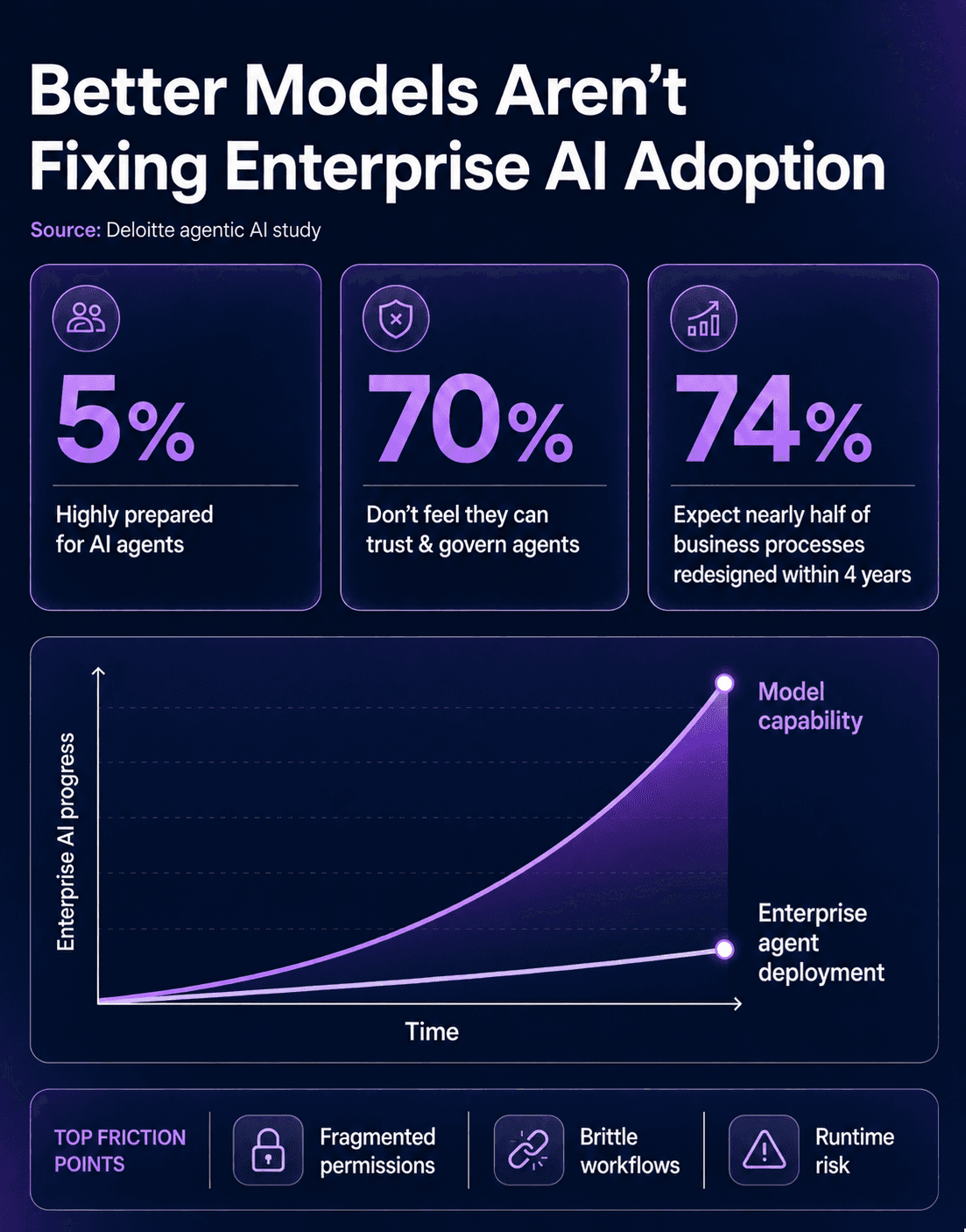
What I find interesting is that model capability doesn't seem to be the main problem anymore.
- Models can reason better.
- They can use tools.
- They can call APIs.
- They can work across much larger contexts.
- They can increasingly complete multi-step tasks on their own.
But inside an enterprise, being capable is only part of the job.
Where the real friction is
When you ask an agent to actually execute a workflow, raw model capability is only one part of the battle. The rest comes down to the messy realities of enterprise tech:
Fragmented permissions: An agent may need to work across five different systems, each with its own identity, access model, and restrictions.
Brittle workflows: Real business processes often depend on exceptions, institutional knowledge, and context that lives in people's heads rather than clean documentation.
Runtime risk: A model performing well on a benchmark is one thing. Giving it the ability to autonomously issue a refund, change a claim, or move customer data is another. In those workflows, even a small failure rate can have very real consequences.
This may explain why we keep seeing impressive agent demos, while so much enterprise AI still ends up as chatbots, copilots, and tightly constrained workflows.
Froda AI provides runtime governance infrastructure for autonomous AI systems — closing the gap between what agents can do and what an enterprise can safely let them do. Request a demo.