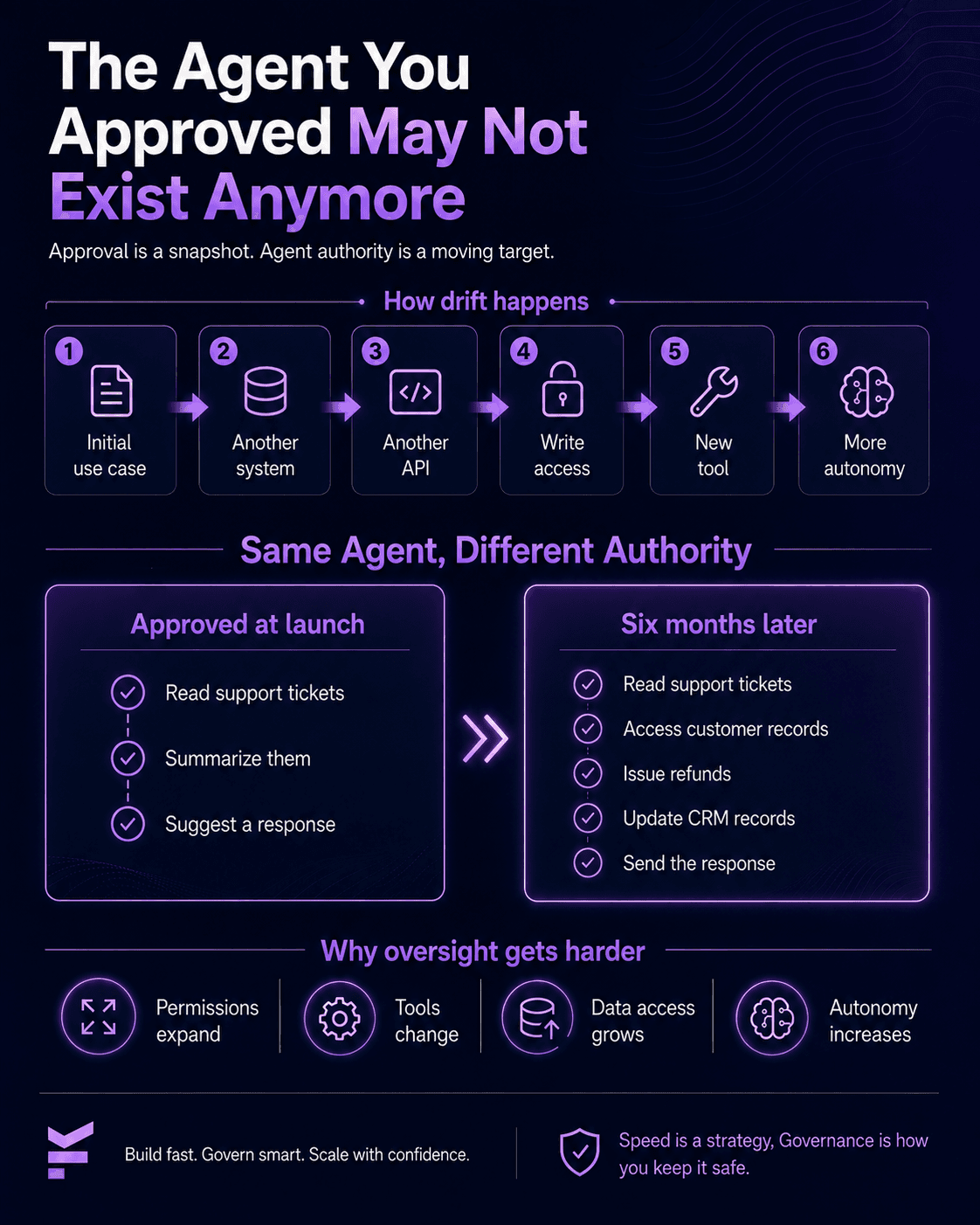
Most AI agents don't stay exactly the way they were when they were first approved. They tend to pick up more access and responsibility as people find more things for them to do.
Imagine a team starts with a pretty simple use case. Maybe the agent only needs to read data from one internal system. A few weeks later, they want it to pull information from somewhere else too. Then it needs another API. At some point, read access is no longer enough, so it gets permission to write back to a system. Someone adds another tool. Eventually, it starts doing a few things on its own that a person used to approve manually.
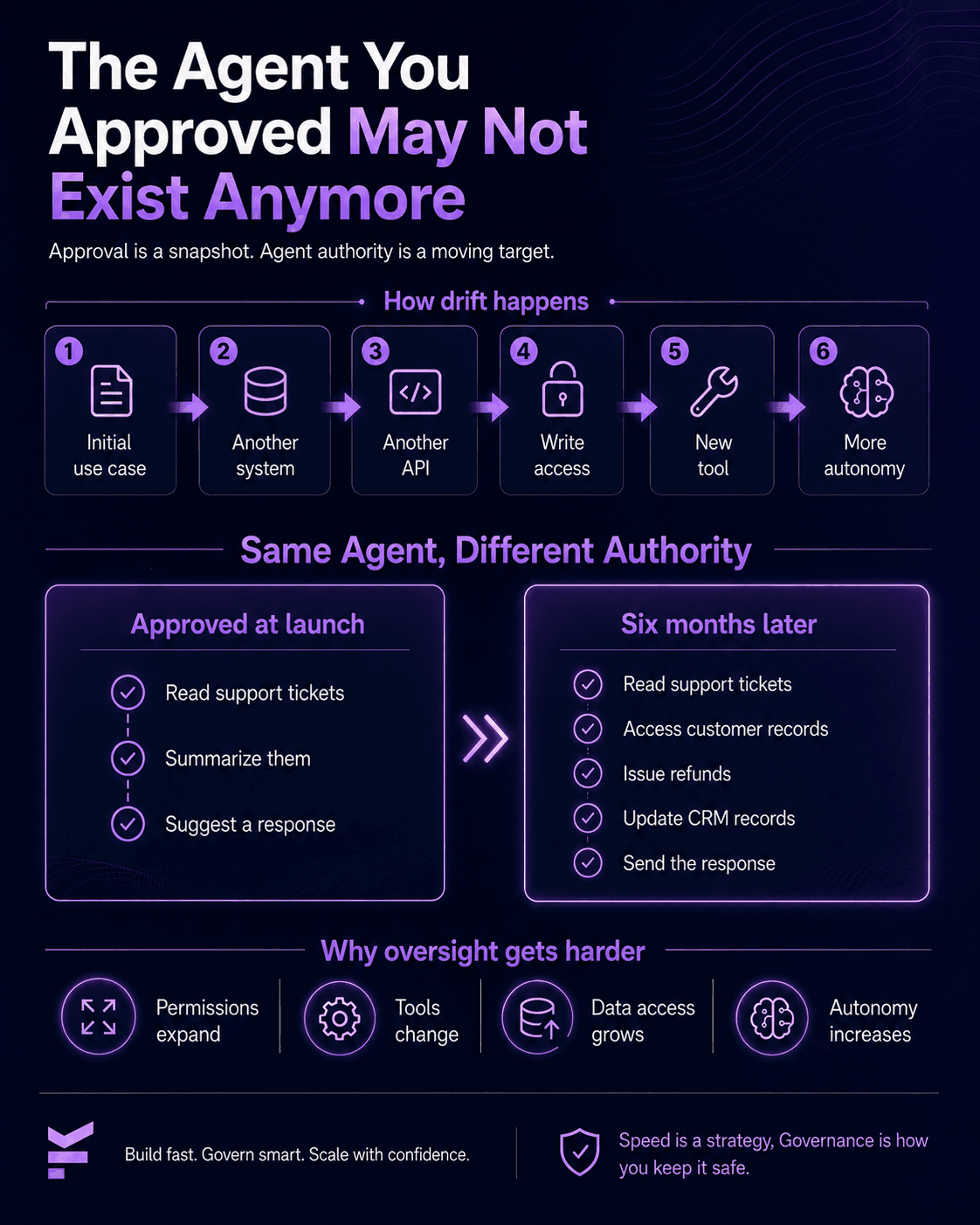
None of those changes feels like a big deal when you look at them one at a time. But six months later, the agent you are governing may have very different access, tools, and authority from the one that was originally approved.
And that is where oversight gets difficult.
Governance built around checkpoints
Most enterprise governance is still built around checkpoints:
- Approve the vendor.
- Review the use case.
- Classify the risk.
- Document the system.
- Approve deployment.
That makes sense when the thing being governed stays relatively stable.
But agents don't necessarily stay stable. Their tools can change, permissions can expand, workflows can evolve, data access can grow, level of autonomy can increase. And new agents can start depending on them. The risk profile can change even when nobody makes a single decision that feels like a major change.
Same project, different authority
Imagine an agent that was originally approved to:
Read support tickets → summarize them → suggest a response
A few months later it can:
Read support tickets → access customer records → issue refunds → update CRM records → send the response
Same underlying project but completely different authority.
The question governance has to ask
I think this is going to become an increasingly important part of AI governance. Because approving an agent is a snapshot. But the agent's permissions, tools, integrations, and autonomy are a moving target.
So the governance question can't only be:
"Did we approve this agent?"
It also has to be:
"What is this agent allowed to do today, and do we know when that changes?"
Froda AI provides runtime governance infrastructure for autonomous AI systems — tracking what every agent is actually allowed to do today, and flagging it the moment that changes. Request a demo.